
UPI Is Changing Again: What Will New Merchant Charges Mean for India’s Cashless Economy?
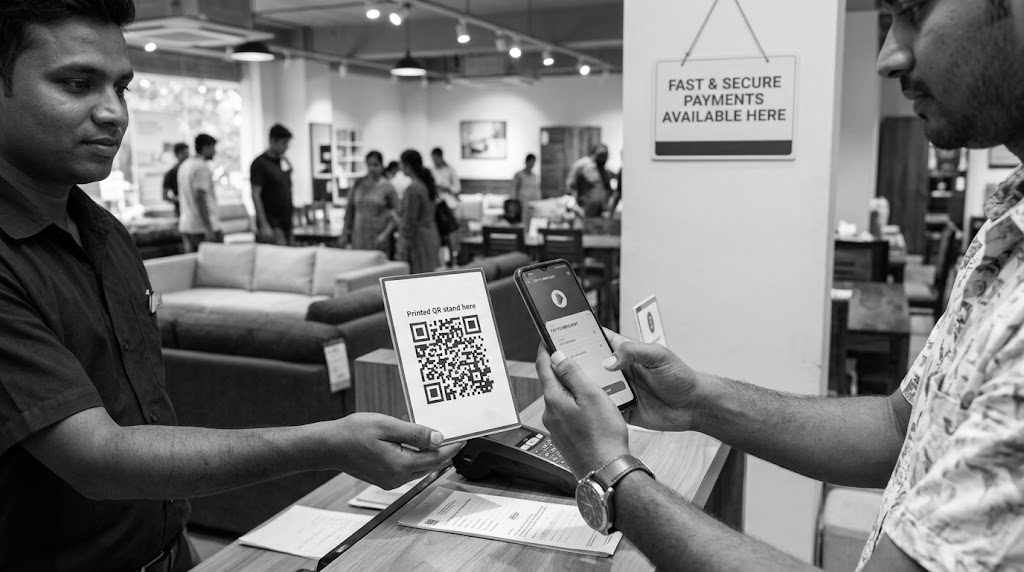
A QR code has become one of the most familiar symbols of India's digital economy. From a roadside tea stall to a large retail outlet, millions of businesses now accept payments through the Unified Payments Interface (UPI), allowing customers to pay instantly without carrying cash. But this largely frictionless system is entering a new phase.
From October 15, 2026, selected UPI payments made to merchants above ₹2,000 will attract a Merchant Discount Rate (MDR) of 0.4 per cent, subject to a maximum charge of ₹300 per transaction. The move marks a major shift after years of a zero-MDR regime for UPI merchant payments. The change, however, does not mean consumers will suddenly be charged for using UPI. Person-to-person payments will remain free, while merchant transactions up to ₹2,000 will also remain outside the new MDR framework. The government says about 96 per cent of person-to-merchant transactions will remain unaffected.
That distinction is important because the debate is not simply about whether UPI will become expensive. It is about who will bear the cost of India's enormous digital-payment infrastructure, whether merchants will continue accepting UPI for larger purchases and what the change could mean for India's long-term move towards a less-cash economy.
Under the new framework, an eligible merchant receiving ₹3,000 through UPI would face an MDR of ₹12. A ₹10,000 transaction would attract ₹40, while a ₹50,000 transaction would mean ₹200. For transactions of ₹75,000 and above, the MDR is capped at ₹300. Thus, a ₹1 lakh eligible merchant transaction would not attract ₹400; the maximum MDR would remain ₹300.
The charge is neither a tax nor a fee collected by the government or the National Payments Corporation of India (NPCI). MDR is distributed among participants in the payment ecosystem, including banks and payment application providers, to support the operation and expansion of UPI. The new framework applies only to specified person-to-merchant (P2M) payments. Person-to-person transactions remain completely free regardless of their value. This means someone sending ₹10,000 to a family member will not suddenly face a 0.4 per cent UPI charge.
The ₹2,000 threshold is central to understanding the new system. According to the government, P2M transactions up to ₹2,000 will remain free and account for more than 95 per cent of P2M transaction volume. Overall, only around 4 per cent of merchant transactions by volume are expected to be affected by the new MDR structure.
UPI's enormous transaction volume provides some perspective. NPCI data shows that UPI processed 24.51 billion transactions worth about ₹29.82 lakh crore in August 2026, compared with 23.66 billion transactions worth ₹29.88 lakh crore in July. The number of banks live on the platform had reached 752 in August. The figures show why even a rule affecting a relatively small share of transactions can have a significant impact on the wider payment ecosystem. At the same time, the government expects the limited scope of MDR to prevent the change from affecting routine low-value digital payments.
Another important detail is the treatment of small businesses. Merchants covered under the P2PM framework and receiving up to ₹1 lakh a month through UPI QR transactions will continue to receive zero-MDR treatment. The framework is specifically aimed at small vendors and does not require them to obtain GST registration or replace their existing QR infrastructure. However, a merchant crossing the ₹1 lakh monthly threshold for three consecutive months can move into the standard P2M category.
This provision matters because India's digital-payment revolution has been driven not only by organised retail chains but also by small shops, street vendors, local service providers and neighbourhood businesses. For a small vegetable seller accepting a few hundred rupees at a time, the new framework is therefore very different from its impact on a furniture showroom receiving ₹50,000 or ₹1 lakh through UPI.
The new system is also more complicated than a simple 0.4 per cent charge. Certain essential or high-volume categories will have a flat ₹5 MDR on specified transactions above ₹2,000. These include sectors such as railways, telecommunications, insurance, fuel and agricultural inputs. Government utility bill payments, including electricity, water and piped gas, as well as specified educational fee payments, also receive the flat-rate treatment.
Capital-market related payments are treated differently. Transactions involving mutual funds, securities, stockbrokers and dealers will attract an MDR of 0.02 per cent, subject to a ₹300 cap. UPI AutoPay and automated recurring payments, including certain utility bills, OTT subscriptions and recurring investments, will not attract MDR under the framework. These exemptions and lower rates are important because a uniform 0.4 per cent charge could have produced a very different impact across industries.
Another misconception surrounding the announcement is that consumers will face a monthly UPI limit or have to pay after making a certain number of transactions. The new framework does not introduce a monthly quota or tiered limit of free UPI transactions for individuals. Consumers can continue making UPI payments without a commercial transaction fee. Existing daily transaction limits, which can vary depending on the category and bank, are risk-management measures rather than new charges imposed under the MDR framework.
The answer to why MDR is being introduced now goes back to the way UPI grew. The zero-MDR framework introduced in January 2020 helped accelerate merchant adoption by making digital payments inexpensive for businesses. Over time, QR codes became common across India's retail economy. But the same success created another problem: running a payment network at enormous scale requires continuous spending on technology, banking infrastructure, cybersecurity, fraud prevention and technical support.
Banks and payment companies have argued that maintaining such an ecosystem without a direct revenue stream is difficult to sustain. Industry estimates cited in recent reports put the annual cost of operating the broader UPI infrastructure at around ₹20,000 crore, while the government had earlier supported the zero-MDR model through budgetary incentives of roughly ₹2,000 crore a year. RBI Governor Sanjay Malhotra has also pointed to the basic economic question of who ultimately bears the cost of maintaining the system, while noting that the decision on MDR rests with the government.
The new framework is therefore an attempt to introduce a revenue mechanism without putting a direct fee on ordinary users or the smallest merchants. But the controversy begins with the practical impact on businesses.
The timing is particularly significant because India's major festive shopping period falls around October and November, when purchases of clothing, electronics, jewellery, household goods and other products can be considerably higher than ₹2,000. The Retailers Association of India has warned that the additional cost could encourage some businesses to favour cash, particularly where profit margins are already narrow. The Clothing Manufacturers Association of India has also raised concerns about the timing of the change.
The concerns are no longer limited to one region. Fuel-pump dealers in Madhya Pradesh have said they plan to stop accepting UPI payments above ₹2,000 from October 16, citing the MDR issue. Traders in other parts of the country have also expressed opposition. These developments do not establish that UPI adoption will fall nationally, but they highlight a potential behavioural issue: even if consumers are not charged, merchants may reconsider how they accept high-value digital payments.
The government has sought to prevent merchants from passing the cost to customers. Banks have been advised to ensure that merchants do not pass MDR charges on to customers, while UPI application providers cannot impose platform fees or hidden charges on individuals under the new framework.
But enforcement will be crucial. A merchant does not necessarily need to add a separate "UPI fee" to influence consumer behaviour. A business could theoretically prefer cash, ask customers to use another payment method or incorporate payment-related expenses into its broader pricing structure. That is why the real impact may only become clear after October 15, when the framework starts operating at scale.
This is perhaps the biggest question for India's cashless economy. The government has said it does not expect the new MDR to cause a significant shift towards cash because only around 4 per cent of total transaction volume will be affected. But merchant behaviour will still be worth watching.
A customer purchasing a ₹1,000 item is unlikely to notice any change. A family buying furniture for ₹50,000 or a customer making another large purchase could encounter a different payment preference if a merchant is unwilling to absorb the MDR. That distinction could become particularly visible during the festive season.
Reuters reported that retailer groups have warned that high-value purchases above ₹2,000 could become a point where some merchants prefer cash, especially given the thin margins of smaller businesses. At the same time, there is no evidence yet that India is broadly reversing its shift towards digital payments. UPI's transaction volumes remain at record levels, and the vast majority of transactions will continue without MDR.
One less visible area where the new rules could have an impact is the financial market. Payments involving brokers, mutual funds and securities dealers will attract the lower 0.02 per cent MDR, capped at ₹300. Brokerage companies have raised concerns about how such costs could affect their business models. Reuters reported that Zerodha co-founder Nithin Kamath questioned how brokers could indefinitely absorb additional costs associated with UPI payments.
This shows that MDR is not only a retail-shop issue. Its effects could extend into financial services and other parts of India's digital economy.
The debate has also moved beyond economics. A public-interest litigation has been filed in the Supreme Court challenging the new framework, with the petition questioning its statutory basis, transparency and safeguards. The legal challenge remains a matter for the court and does not by itself determine whether the framework will ultimately stand or change. That means the October 15 rollout could take place alongside continuing legal and industry debate.
The government has proposed that 5 per cent of total MDR collections be placed in a dedicated fund aimed at encouraging UPI adoption among small merchants, particularly in smaller and underserved markets. If the additional revenue helps improve cybersecurity, infrastructure, reliability and access, it could strengthen the system over the longer term.
But if merchants increasingly avoid UPI for high-value purchases, the policy could create a different problem: a digital payment system that remains extremely popular for small transactions but becomes less attractive for larger ones.
That is why the coming months will be important. India's UPI journey began with a simple proposition: make digital payments fast, easy and accessible. It succeeded to an extraordinary extent. Today, the question is no longer whether Indians are willing to use digital payments. The bigger question is how India can pay for the infrastructure behind that convenience without making the system less convenient for the people and businesses that depend on it.
From October 15, that experiment will begin. For ordinary users, the immediate message remains reassuring: UPI is not becoming universally chargeable. Person-to-person transfers remain free, payments up to ₹2,000 to merchants remain free, eligible small merchants remain protected, and there is no new monthly fee for consumers.
But for businesses handling larger payments, the economics are changing. And for India's cashless-economy ambition, the real story will not be the 0.4 per cent figure alone. It will be whether merchants continue displaying those familiar QR codes when the bill crosses ₹2,000 — and whether customers continue reaching for their phones when they do.