
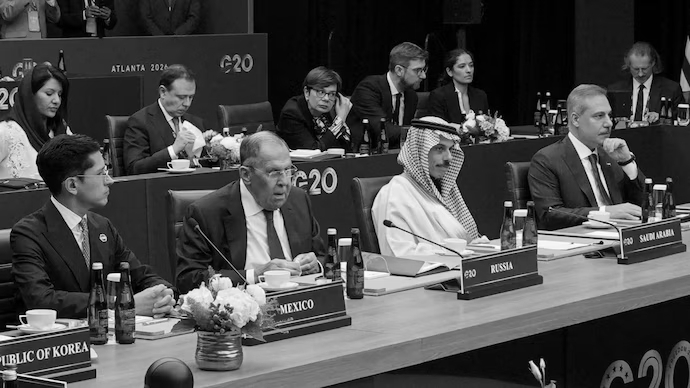
US Scraps G20 Group Photo After European Ministers Refuse To Pose With Russia's Lavrov
The United States cancelled the traditional G20 group photograph in Atlanta after several European foreign ministers objected to being pictured alongside Russian Foreign Minister Sergey Lavrov, exposing deep divisions among Western allies over Moscow's participation amid the ongoing Russia-Ukraine war.
The disagreement erupted on Friday, the opening day of the two-day G20 foreign ministers' meeting, when several European delegations threatened to boycott or walk out of the photograph rather than stand alongside Lavrov. Some participants reportedly suggested taking two separate photographs, one with Lavrov and another without him. However, US Secretary of State Marco Rubio scrapped the entire photo opportunity, fearing the controversy would overshadow the discussions. The meeting itself proceeded as scheduled.
German Foreign Minister Johann Wadephul said there could be no normality with Russia, explaining his opposition to the photograph. Polish Deputy Prime Minister Radosław Sikorski said he was not alone in refusing to be photographed with Lavrov. European representatives also stressed that the photograph could send a misleading signal of normal diplomatic relations with Moscow.
The tensions extended beyond the photograph. British Foreign Secretary Ed Miliband directly confronted Lavrov during the meeting, accusing Russia of being the aggressor in the war. Referring to a Russian drone attack on Dnipro that reportedly killed 15 people, Miliband said Moscow had repeatedly targeted innocent civilians. He also argued that Russian President Vladimir Putin had failed to win the war because of Ukrainian resistance and international support.
Russia's participation had already triggered objections among several G20 members, particularly amid continued attacks on Ukraine and US President Donald Trump's efforts to improve ties with Moscow. Washington's recent decisions, including waiving fresh sanctions on Russia and temporarily restricting logistical and intelligence assistance to Kyiv, have further strained relations with European allies.
Russian Foreign Ministry spokeswoman Maria Zakharova claimed that visa complications for the Russian delegation were resolved only at the last minute, suggesting that not everyone in Washington was happy about Lavrov's attendance. She said the Russian foreign minister intended to push for the swift reform of global economic institutions.
Addressing the gathering, Rubio urged G20 members to cooperate amid interconnected geopolitical and economic crises. He highlighted disruptions to global energy and food supplies, international trade and freedom of navigation, warning that these developments threatened the foundations of the global economic order.
The two-day meeting also covers the Russia-Ukraine war, the US-Israeli conflict with Iran, American tariffs and China's activities in the South China Sea. However, divisions over major international issues have raised questions about the group's ability to reach consensus on a joint declaration.
Attention will now turn to the December G20 leaders' summit in Miami, where Trump has invited Putin. Whether the Russian president attends remains uncertain, but his potential participation could create another diplomatic challenge for Western leaders.