
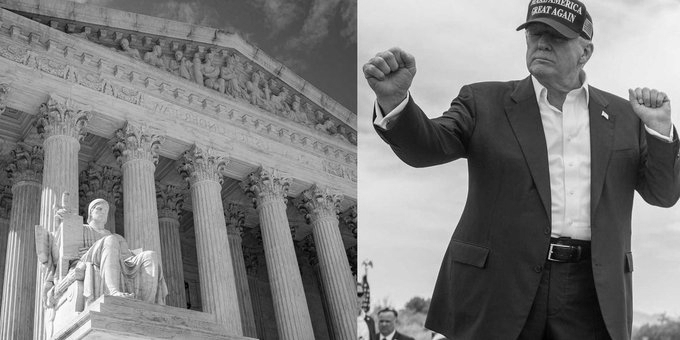
US Supreme Court Gives Trump Interim Win On Mail Voting Restrictions Ahead Of Midterms
President Donald Trump’s effort to tighten mail in voting rules ahead of the November US midterm elections cleared a major legal hurdle Monday after the Supreme Court lifted one injunction blocking parts of his executive order. However, a separate nationwide injunction remains in force, meaning the administration still cannot fully implement the plan.
The 6: 3 ruling by the conservative majority did not decide whether Trump’s March executive order is constitutional or lawful. Instead, the justices found that a lawsuit filed by 23 mostly Democratic governed states and the District of Columbia was brought too early because the states had not shown sufficient concrete harm from federal implementation at that stage. The court left open the possibility of further challenges as the November election approaches.
Trump’s order directs the Department of Homeland Security to compile lists of US citizens eligible to vote in each state. It also directs the Justice Department to prioritise investigations and prosecutions involving election officials who issue federal ballots to people deemed ineligible. The order further seeks to require the US Postal Service to deliver mail ballots only to voters appearing on approved state lists.
A separate injunction issued by US District Judge Indira Talwani on August 11 remains in effect. It prevents USPS from enforcing key requirements of the administration’s mail voting rules nationwide.
Despite that injunction, USPS released a 95 page final rule on Friday designed to implement Trump’s order if the legal barriers are removed. The rule requires states to provide lists of voters who received mailed ballots and unique barcodes for outbound and return ballot envelopes. USPS has said the rules could be implemented quickly if courts allow them to take effect.
Talwani previously ruled that Trump lacked authority to dictate how states administer federal elections, pointing to constitutional powers assigned to states and Congress. The Trump administration argued that the states’ legal challenge was premature.
The timing has intensified concerns among election officials because some states will begin distributing mail ballots within weeks. North Carolina is scheduled to send ballots to military and overseas voters from September 4, leaving little time for major procedural changes.
Democrats and voting rights groups argue that the restrictions could disrupt election preparations and reduce access to mail voting. Republicans and the Trump administration have presented the measures as election integrity safeguards.
Trump has repeatedly criticised mail voting and made unsubstantiated claims linking it to election fraud, despite widespread evidence that voting fraud is rare. Mail voting was used for about 30 per cent of ballots cast in the 2024 presidential election.
The Supreme Court’s latest action therefore gives Trump an important interim victory, but the legality and practical implementation of his mail voting restrictions remain unresolved as the midterms draw closer. Further court battles are expected.