
VB G RAM G Guarantees 125 Days of Rural Employment Across India
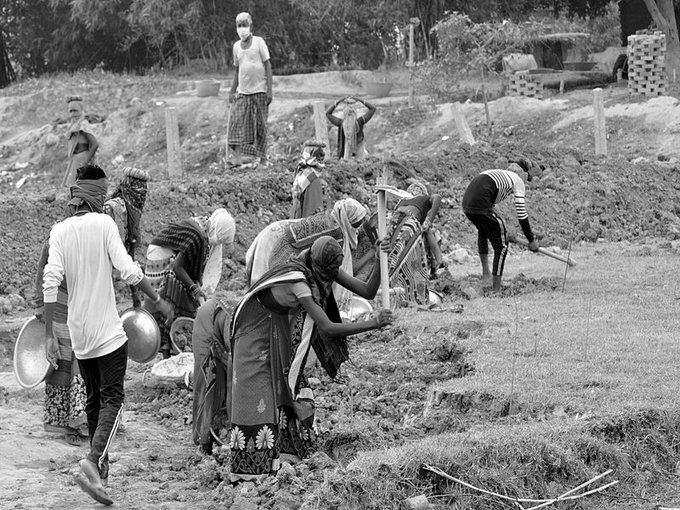
The Viksit Bharat–Guarantee for Rozgar and Ajeevika Mission (Gramin) (VB-G RAM G) has introduced a new framework for rural employment by guaranteeing up to 125 days of wage employment to every rural household whose adult members volunteer for unskilled manual work in a financial year.
The VB-G RAM G Act, 2025 came into force across all rural areas of the country on July 1, 2026, replacing the Mahatma Gandhi National Rural Employment Guarantee Act (MGNREGA). The new framework links employment generation with the creation of durable rural assets, livelihood infrastructure and climate-resilient development.
The employment guarantee has been increased from the earlier 100 days to 125 days. The Act also provides for a pause in employment guarantee for an aggregate period of up to 60 days during peak agricultural sowing and harvesting seasons, with states identifying the relevant periods based on local conditions.
The programme focuses on four broad areas — water security, core rural infrastructure, livelihood-related infrastructure and mitigation of extreme weather events. Its planning mechanism is centred on Viksit Gram Panchayat Plans (VGPPs), under which Gram Panchayats and Gram Sabhas identify local development needs, map existing assets and prioritise works.
The VGPP framework includes 318 types of permissible works and uses GIS, Yuktdhara, PM Gati Shakti and other digital platforms to identify infrastructure gaps and avoid duplication. Plans are consolidated from the block level to the national level.
As of September 24, 2026, the programme had recorded 10.88 crore active workers, generated more than 31.69 crore person-days and created 2.83 lakh assets. Women accounted for 61.65 per cent of participation. More than 2.81 crore workers from about 2.23 crore rural households had been provided employment on demand.
The scheme had around 20.16 lakh active worksites, while nearly 2.31 lakh Gram Panchayats were executing works. The average wage rate stood at ₹283.24 per day, while 15.17 crore Gramin Rozgar Guarantee Cards had been issued.
For 2026-27, the Centre has made a ₹95,692.31-crore central share provision, with the overall programme outlay, including the estimated state share, expected to exceed ₹1.51 lakh crore. The funding ratio is 90:10 for the North-Eastern and Himalayan states and certain Union Territories, and 60:40 for other states and Union Territories with legislatures.
The framework also strengthens worker protections through provisions for unemployment allowance when work is not provided within the prescribed period and compensation for delayed wage payments.
Technology is being used extensively for implementation and monitoring through e-KYC, face and biometric authentication, geo-tagging, electronic measurement books, direct benefit transfers, real-time dashboards and AI-enabled analytics.
The government says the new framework is intended to move rural employment beyond wage support by combining employment with productive asset creation, village-level planning, sustainable livelihoods and climate resilience.