
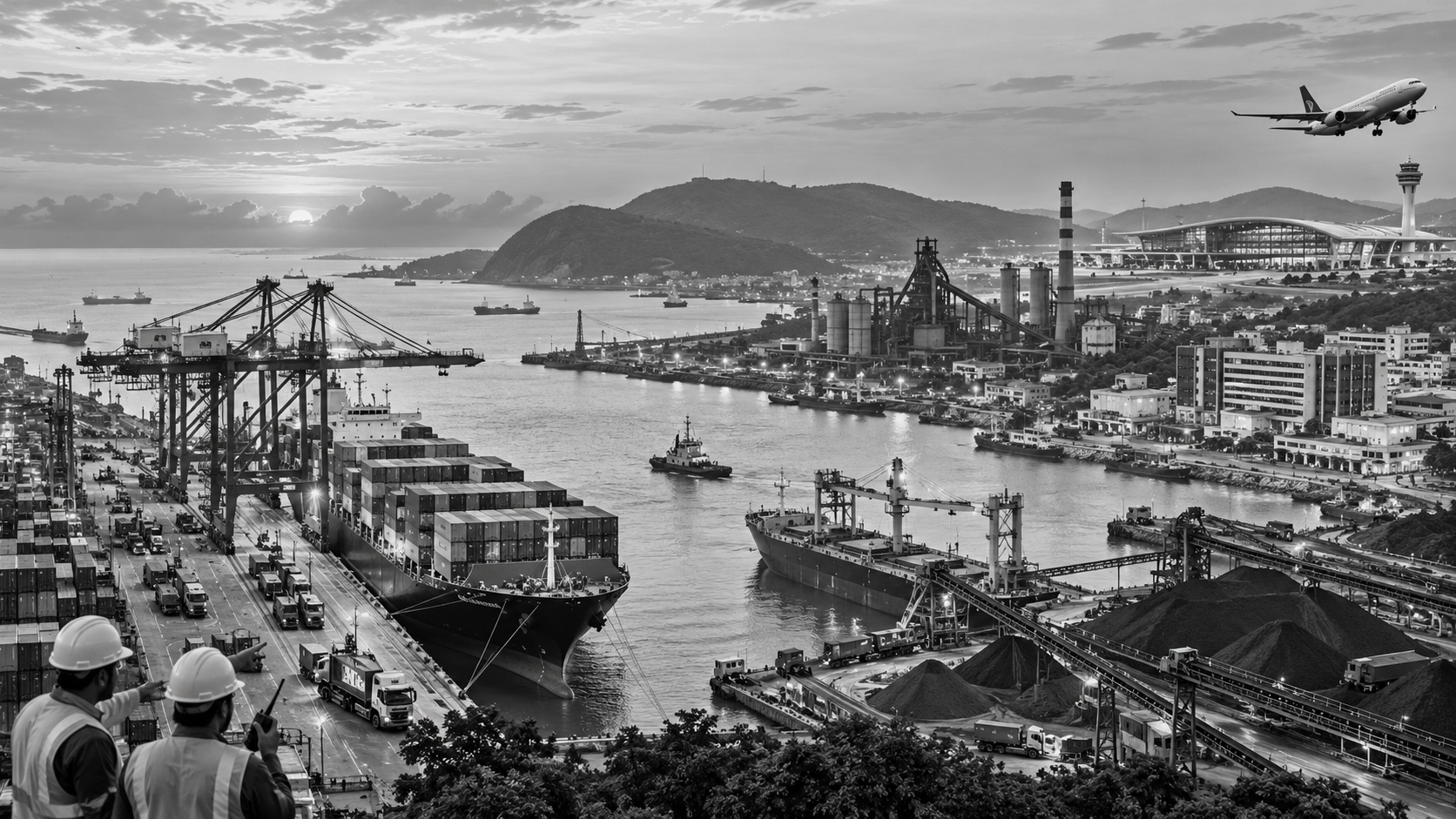
Visakhapatnam Port: Connecting Global Trade, Industrial Growth and Local Livelihoods
From a maritime gateway established in 1933 to a record 50 million tonnes of cargo in 196 days, Visakhapatnam Port is shaping Andhra Pradesh’s industrial future. Its next challenge is to reach 100 million tonnes while sustaining jobs, improving logistics and balancing growth with environmental concerns.
Every ship entering Visakhapatnam Port carries more than cargo. Crude oil feeds energy infrastructure, coal and minerals support industrial production, fertilisers serve agriculture, and containers connect manufacturers with international markets. Behind these movements lies a vast network of workers, transport operators, industries and coastal communities whose fortunes are linked to the sea.
The Visakhapatnam Port Authority (VPA) reached a significant milestone on October 13, 2026, handling 50 million tonnes (MT) of cargo in just 196 days during the financial year 2026–27. According to a Press Trust of India report published on October 14, the port achieved the same milestone in 213 days in 2025–26 and 224 days in 2024–25. VPA Chairperson J.S. Bindra expressed confidence that the port would handle 100 MT during the current financial year.
The achievement reflects not only rising cargo volumes but also the importance of operational efficiency, specialised terminals and transport connectivity. For Visakhapatnam, the port is more than an economic asset; it is part of the infrastructure that helped shape the city’s industrial identity.
A legacy spanning nine decades
Visakhapatnam’s maritime connections extend back centuries, when ships anchored offshore and small masula boats transferred cargo to the coast. The modern port opened to ocean traffic on October 7, 1933, with the arrival of the passenger vessel S.S. Jaladurga. It was formally inaugurated later that year.
Over the decades, the port developed alongside the city’s industrial expansion, supporting the movement of petroleum, minerals, fertilisers and other industrial materials. Its railway connections extended its reach into inland markets, while major industrial establishments strengthened demand for maritime services.
The port did not single-handedly transform Visakhapatnam, but it became a vital part of the infrastructure supporting its evolution into a major industrial and commercial centre.
A national maritime heavyweight
Visakhapatnam Port handled a record 91.17 MT in 2025–26, compared with 82.62 MT in 2024–25 and 81.09 MT in 2023–24. Its latest completed financial year marked growth of approximately 10.3%.
It ranked fourth among India’s major ports and second among east-coast ports in cargo throughput during 2025–26. Deendayal Port handled 160.11 MT, Paradip Port 156.45 MT and Jawaharlal Nehru Port 102.01 MT, ahead of Visakhapatnam.
The latest financial year began with another strong performance. The port crossed 20 MT on June 14, 25 MT on July 3, 30 MT on July 23, 35 MT on August 15, 40 MT on September 3, 45 MT on October 7 and 50 MT on October 13. The final milestone was achieved 17 days earlier than in 2025–26 and 28 days earlier than in 2024–25.
Reaching 100 MT will require the port to handle another 50 MT during the remainder of the financial year. Based on the 196 days elapsed by October 13, that requires an average of approximately 0.296 MT daily, against roughly 0.255 MT daily during the first 196 days. This is a pace calculation rather than a forecast, as cargo demand, vessel arrivals and operating conditions can change.
What moves through the port?
The port handles a broad range of commodities, including crude oil, petroleum products, coal, coke, iron ore, manganese ore, fertilisers, alumina, chemicals, containers and general cargo.
Its specialised terminals use cranes, conveyor belts, pipelines and other equipment to handle different types of shipments. In June 2026, the port discharged a record 2.1 MT of crude oil in a calendar month, surpassing its previous record of 1.8 MT in May. In September, it handled the Belgian-flagged ATREBATES, a 339.5-metre-long crude-oil carrier, at its Single Point Mooring facility.
The cargo connects the port with industries across the region. Coal and coking coal support power generation and steelmaking; iron ore and minerals serve steel producers and overseas buyers; fertilisers support agricultural supply chains; and petroleum and chemical products feed energy and manufacturing operations.
Containerised and general cargo add another dimension, allowing machinery, components and manufactured goods to move between factories, warehouses and markets. Seafood exports also form part of the wider coastal economy, although their volumes should be distinguished from the port’s principal bulk-cargo statistics.
From steel to pharmaceuticals and data centres
The Visakhapatnam Steel Plant, operated by Rashtriya Ispat Nigam Limited, illustrates the relationship between maritime logistics and industrial production. Steelmaking requires substantial raw-material supplies, including coking coal, iron ore and other inputs. Ports and railways can move these commodities in bulk, although the plant’s actual procurement routes vary and must be confirmed through company data.
The pharmaceutical industry around Visakhapatnam offers another example. Jawaharlal Nehru Pharma City at Parawada has reported 104 operating pharmaceutical companies and approximately 30,000 employees within the park. Manufacturers may use maritime transport for suitable chemical inputs, intermediates and equipment, while finished medicines and urgent consignments can move by road, sea or air depending on their requirements.
The new Alluri Sitarama Raju International Airport at Bhogapuram, which commenced commercial operations on August 17, 2026, adds another connectivity option for businesses, investors and technical specialists. The airport complements the port rather than replacing it: ships carry large volumes of bulk cargo, while aviation supports faster passenger movement and eligible time-sensitive freight.
Visakhapatnam’s emerging data-centre sector adds a potential new source of logistics demand. Google announced a US$15-billion AI hub investment in the region, with plans for hyperscale data-centre infrastructure. Servers, electrical equipment, cooling systems and construction materials may require maritime or air transport. However, data centres depend most directly on reliable electricity, fibre connectivity and cooling; the port’s contribution is through the supply chain used to build and equip them.
The people behind the cargo
The port’s economic footprint extends beyond its direct employees. Dockworkers, crane operators, truck drivers, railway personnel, shipping agents, warehouse workers, maintenance teams and small suppliers all participate in the wider logistics chain.
However, a verified, consolidated current figure for the total number of people whose livelihoods depend on the commercial port is not available in the sources reviewed. Direct employees, contract workers and people employed in dependent industries must be counted separately.
Visakhapatnam’s fishing economy offers a separate illustration of maritime dependence. The district administration has reported that the fishing harbour supports approximately 12,000 families directly and indirectly, while another profile estimates nearly 20,000 people work across fishing and its supply chain. These figures relate to the fishing economy, not the commercial port, and should not be combined into a single employment total.
The port authority also has a formal employee-welfare framework, including the Visakhapatnam Port Employees’ (Welfare Fund) Regulations, 1967. Employee representation is part of port governance, while merchant navy seafarers have separate welfare arrangements through organisations such as the Seamen’s Provident Fund Organisation and the Seafarers Welfare Fund Society. Current figures for active unions, union membership and seafarers associated with the port require further official verification.
The strategy behind the growth
Reaching 100 MT will depend on more than increasing ship arrivals. Mechanisation, faster vessel turnaround, digital monitoring, specialised terminals and better cargo evacuation are all important.
The port reported that average vessel waiting time fell by 37% in April–September 2026, from 0.71 hours to 0.45 hours. It handled 46.14 MT during that period, compared with 43.09 MT in the corresponding period a year earlier.
Railways are another crucial link. The port’s railway system handled 33.75 MT of cargo in 2025–26. In August 2026, the Union Ministry of Ports, Shipping and Waterways approved a ₹334.89-crore, 3.584-kilometre internal flyover intended to separate road and rail traffic and address bottlenecks at nine level crossings.
These improvements can reduce delays between ships and inland destinations. Public-private partnerships and terminal modernisation can also expand operational capacity, provided projects are implemented effectively.
Competition, sustainability and the future
Andhra Pradesh is developing additional maritime infrastructure, including Machilipatnam, Mulapeta, Ramayapatnam and Kakinada SEZ Port. These projects may attract particular cargoes and serve new industrial locations, while also increasing the state’s overall port capacity.
Visakhapatnam’s established terminals, industrial connections and logistics network give it a strong foundation, but future competitiveness will depend on service quality, investment and efficient cargo movement.
Growth must also be balanced against coal dust, emissions, congestion, coastal ecosystems and the needs of nearby communities. Environmental monitoring, cleaner handling systems, worker safety and reliable urban infrastructure will be important measures of sustainable development.
Visakhapatnam Port’s legacy began with the transformation of a coastal harbour into a modern maritime gateway. Today, its role extends from steel and petroleum to pharmaceuticals, manufacturing and emerging technology infrastructure. Its next milestone will not be measured by cargo records alone, but by whether growth strengthens industries, creates meaningful opportunities and benefits the wider city and state.