

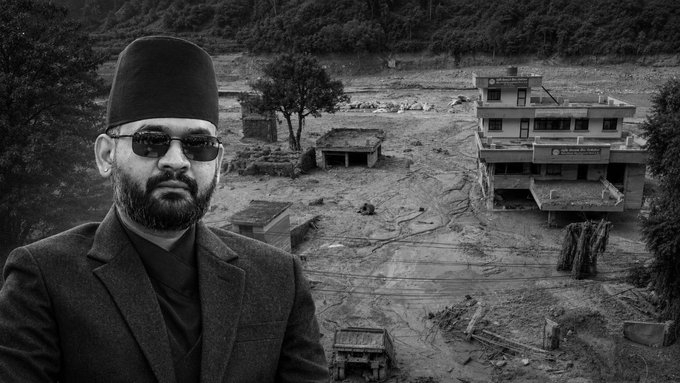
Who Will Pay For Nepal’s Himalayan Tsunami? Kathmandu Points To India, China And US
Who will pay for Nepal’s Himalayan tsunami? Nine days after a massive wall of water, mud, ice and rock tore through mountain valleys, Kathmandu is demanding climate justice while rescue teams continue searching for thousands of missing people.
The disaster struck on August 26 after a glacier and underlying rock collapsed near the Nepal Tibet border, sending a devastating flood downstream. Entire settlements disappeared, roads and bridges were destroyed and hydropower projects were swallowed by debris.
Nepal’s latest figures show 1,252 people have died and more than 4,200 remain missing. Families are still waiting for news, while rescue teams continue digging through mud and debris.
But Nepal’s political conversation has now shifted towards a bigger question: who should pay for the devastation?
Foreign Minister Shisir Khanal has pointed to China, the United States and India, arguing that they are among the world’s biggest greenhouse gas emitters and therefore carry greater responsibility for climate change. Nepal contributes less than 0.1% of global emissions, yet its glaciers are melting, mountains are becoming increasingly unstable and climate linked disasters are becoming more dangerous.
Kathmandu has sought climate compensation from the international community and support through the UN backed Fund for Responding to Loss and Damage.
But climate responsibility is complicated. China is currently the biggest emitter, followed by the US and India. Historically, however, the US is the world’s largest cumulative emitter after decades of industrialisation and fossil fuel use. India also has far lower per capita emissions than both China and the US. So judging responsibility simply by today's emissions ranking misses a much bigger debate over historical emissions and fairness.
Prime Minister Balendra Shah has meanwhile focused on rescue and relief. Speaking in Parliament, he thanked India and China for sending technical teams from the first day to assess the destruction and conduct aerial surveillance. India has also sent additional relief supplies and a specialist rescue team.
There are questions about whether warning signs were missed. Scientists studying satellite imagery reportedly observed faster glacier movement, muddy meltwater and cracks in surrounding rock before the collapse. These clues could not have predicted the exact moment of failure, but they suggest growing instability.
The collapse reportedly occurred at 8:37 a.m. Monitoring systems detected seismic activity, but it did not resemble a conventional earthquake, so no immediate alert was issued. A river gauge was then swept away. Local authorities tried warning communities, while a nationwide alert reportedly arrived at 9:15 a.m., 38 minutes later.
That delay could be fatal during a Himalayan flash flood.
Nepal has every right to demand climate justice. But with thousands still missing and around 20,000 homes potentially needing reconstruction, the immediate priority is rescue, recovery and stronger early warning systems.
The climate responsibility debate must happen. But right now, Nepal needs the world to help prepare for the next Himalayan tsunami, before it strikes.