
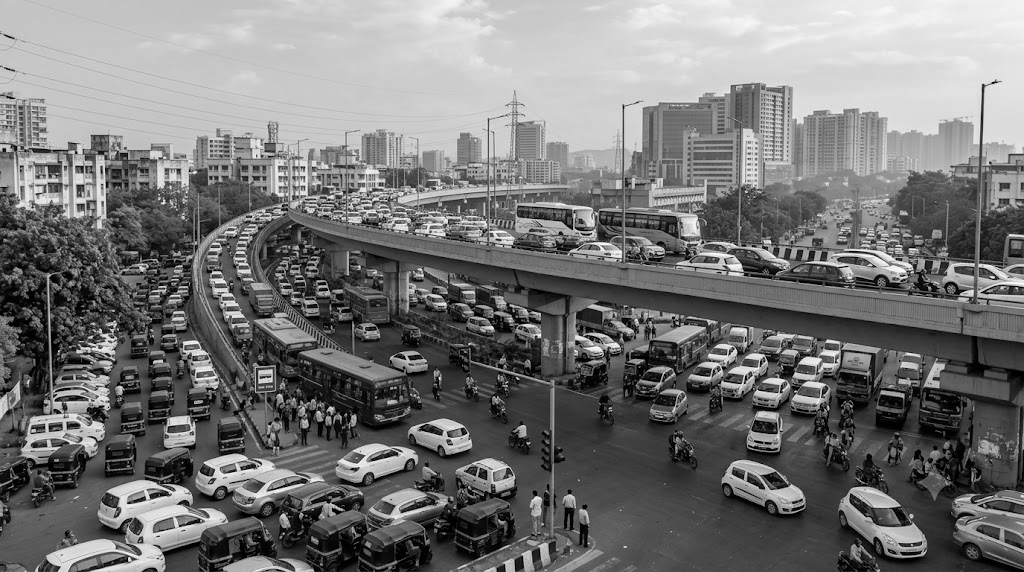
Why Indian Cities Are Struggling With Traffic Despite New Flyovers
For millions of commuters in India's biggest cities, the daily battle with traffic has become an unavoidable part of urban life. Roads are widened, flyovers are inaugurated, underpasses are opened and elevated corridors are planned with the promise of faster and smoother journeys. Yet, after the initial relief fades, congestion often returns, sometimes at the same location and sometimes at the next junction. The paradox is becoming increasingly difficult to ignore: India is building more road infrastructure, but its cities are still struggling to move people efficiently.
The scale of the problem becomes clearer when India is viewed not just through individual cities but as a country. According to the 2025 TomTom Traffic Index, India was the second-most congested country in Asia, with an average congestion level of 37.4%, behind only the Philippines at 44.6%. Globally, India ranked fifth. The ranking is significant because it shows that India's traffic problem is not restricted to one or two metropolitan centres; congestion has become a broader urban-mobility challenge.
The city-level numbers are even more striking. Bengaluru recorded a congestion level of 74.4%, making it the second-most congested city in the world in 2025. Pune followed at 71.1%, Mumbai at 63.2%, New Delhi at 60.2%, Kolkata at 58.9% and Jaipur at 58.7%. Hyderabad recorded 55.5%. Six Indian cities featured among Asia's 10 most congested cities, underlining the widespread nature of the problem.
These figures point to an important distinction. A city can build infrastructure and still remain congested because traffic is not simply a problem of one road or one junction. It is a network problem involving where people live, where they work, how they travel, how roads connect, how public transport operates and how efficiently traffic is managed. A flyover can remove a signal and allow vehicles to move freely through one junction, but those vehicles still have to enter another road. If that road is narrower or already overloaded, the congestion can simply shift.
This is the central weakness of treating flyovers as a universal solution. The structure may eliminate one bottleneck without eliminating the underlying demand for road space. Traffic that once queued before a signal may now travel quickly across the flyover and then form a longer queue at its exit. Merging traffic, turning vehicles, buses stopping on the road, pedestrians crossing and illegal parking can all reduce the capacity of the road beyond the elevated section. The problem has moved rather than disappeared.
India's second-place position in Asia also has to be understood in the context of rapid urbanisation and motorisation. India's cities have expanded outward, employment has become concentrated in major business districts and millions of commuters travel across metropolitan boundaries every day. At the same time, private vehicle ownership has risen rapidly. Cars and two-wheelers provide flexibility where public transport is unavailable or inconvenient, but when millions of people make the same choice at the same time, the result is intense pressure on limited road space.
The country's urban form adds another layer to the problem. In many cities, affordable housing is increasingly located away from major employment centres. Workers living on the outskirts travel long distances towards technology parks, commercial districts and industrial areas every morning and return home in the evening. This creates predictable tidal flows of traffic that no single flyover can permanently eliminate. The more important issue is not simply how much road exists, but where that road is located in relation to where people need to travel.
Hyderabad offers a useful example because the city has invested substantially in grade separators, flyovers, underpasses and strategic road infrastructure. Yet its overall traffic picture remains complicated. Hyderabad recorded a 55.5% congestion level in 2025, which was actually 1.3 percentage points lower than in 2024. Nevertheless, commuters still lost about 123 hours during rush hour, demonstrating that an improvement in the citywide average does not necessarily mean that individual corridors have become easy to navigate.
The city's rapid expansion has made the challenge particularly difficult. Large employment centres in western Hyderabad attract enormous numbers of commuters from residential areas spread across the metropolitan region. The result is heavy pressure on a relatively small number of corridors during morning and evening peak hours. Transport experts have increasingly argued that Hyderabad cannot solve its growing traffic problem simply by constructing more flyovers, pointing instead to the need for better public transport, pedestrian infrastructure, parking management, traffic enforcement and integrated land-use planning.
That argument goes to the heart of the issue. A road can be physically wide and still function badly. Poor lane discipline, unregulated parking, badly positioned bus stops, pedestrian crossings and uncontrolled turning movements can consume much of the available road capacity. In such circumstances, constructing another elevated structure may provide temporary relief without addressing the factors that are actually slowing traffic.
Hyderabad's experience also demonstrates why traffic statistics must be interpreted carefully. A citywide congestion figure is an average across a large road network. A commuter travelling through Gachibowli, Kondapur, HITEC City or the Financial District during evening peak hours may experience a very different reality from the citywide average. One corridor can improve while another deteriorates, meaning that infrastructure success at one location does not necessarily translate into a smoother journey across the metropolitan area.
Bengaluru presents an even more striking contradiction. The city has become one of the world's symbols of urban congestion despite extensive road and flyover projects. TomTom's 2025 data put its congestion level at 74.4%, up 1.7 percentage points from the previous year. A 10-km journey took an average of 36 minutes and nine seconds, while commuters lost an estimated 168 hours during rush hour.
Yet Bengaluru also demonstrates that flyovers can genuinely work when they address the right problem. The Silk Board double-decker flyover has improved traffic movement around one of the city's most notorious junctions. This is an important counterpoint to the argument that flyovers never work. They can deliver substantial local benefits when they remove a genuine capacity constraint and are properly connected to the surrounding road network.
But Bengaluru's wider problem is much larger than Silk Board. Its technology and business districts generate enormous travel demand, while residential development has spread rapidly into areas far from major employment centres. The resulting journeys place pressure on the Outer Ring Road and other major corridors. Residents of areas such as Varthur and Gunjur have even reported leaving several hours early for airport journeys because traffic has become so unpredictable.
That is more than a traffic inconvenience. It is a sign that unreliable journey times are becoming an economic and social cost. When commuters cannot predict whether a journey will take 40 minutes or two hours, they compensate by leaving much earlier. That behaviour itself can add vehicles to the network during already busy periods, creating a vicious cycle of congestion and uncertainty.
Bengaluru's debate over combining road infrastructure with Metro expansion illustrates how the thinking around congestion is changing. The traditional approach assumes that adding road capacity will automatically reduce congestion. But if additional capacity makes driving easier, some commuters may shift from public transport to private vehicles, while others may change routes or travel more frequently. Over time, the additional road space can be absorbed by additional demand.
This phenomenon is commonly described as induced demand. It does not mean that every flyover automatically causes more traffic or that road expansion is always wrong. It means that infrastructure changes behaviour. A road project has to be assessed not just according to how many vehicles it can accommodate today, but also according to how motorists, businesses and residents are likely to respond to the improved connectivity over several years.
Mumbai faces a different set of constraints. The city has limited physical space, high-density development and a geography that makes large-scale road expansion particularly difficult. Its 2025 congestion level was 63.2%, although this represented an improvement of 3.3 percentage points from 2024. The average 10-km journey took 28 minutes and 51 seconds, and commuters lost approximately 126 hours during rush hour.
The city's newly completed 1.4-km elevated link between BKC and the Western Express Highway provides a fresh illustration of both the promise and the limitations of flyovers. The link is designed to reduce journey times and bypass congested stretches around Kalina, Vakola and Kalanagar. But congestion at the landing points demonstrates the basic limitation of grade-separated infrastructure: the traffic problem does not end where the flyover ends.
The elevated section may perform extremely well while the roads receiving its traffic struggle to absorb the additional vehicles. This is why transport planning must examine the complete corridor rather than measuring only the speed on the structure itself. If the final kilometre of a journey remains heavily congested, the commuter's overall travel time may not improve as much as the flyover's individual performance suggests.
Mumbai's geography also makes public transport particularly important. The city already possesses one of India's most extensive suburban railway networks and an expanding Metro system. Moving large numbers of commuters by rail requires far less road space than moving the same number of people in individual cars. In a dense city where land is expensive and limited, the most efficient transport system is not necessarily the one that allows the greatest number of cars to move.
Delhi offers perhaps the clearest demonstration of why infrastructure alone cannot solve congestion. The capital already has a vast network of flyovers, underpasses and grade-separated roads, yet its congestion level rose to 60.2% in 2025, up 3.5 percentage points from the previous year. Commuters lost about 104 hours during rush hour.
At the same time, Delhi continues to expand its high-speed road network. New elevated corridors and expressway links are intended to redistribute traffic and provide alternative routes. This type of infrastructure can be more useful than a standalone flyover because it can change the pattern of traffic across a wider network. Infrastructure is most effective when it changes the structure of a network rather than merely moving traffic above one intersection.
Delhi's experience also highlights the importance of traffic management. Signal coordination, enforcement, lane discipline, parking control and quick removal of incidents can determine whether existing road capacity is actually usable. A city can add lanes but lose much of their benefit if vehicles stop randomly, intersections are poorly managed or road space is occupied by parking.
Another factor that deserves greater attention is the interaction between roads and other forms of transport. Urban transport is an interconnected system in which road traffic, Metro services, buses, suburban trains, pedestrians and commercial vehicles constantly interact. Improving one mode without considering the others can simply transfer congestion and delays elsewhere. A road may be widened, for example, but if buses continue to stop in traffic lanes or pedestrians lack safe crossings, the additional capacity can quickly disappear.
The country's second-place ranking in Asia is therefore not simply a story about bad roads. It is a story about how Indian cities are growing. Rapid urbanisation, rising vehicle ownership, concentrated employment, long-distance commuting, limited road space and uneven public transport are interacting with one another. The result is congestion that cannot be permanently solved by adding capacity at isolated points.
There is also a fundamental question about what cities are trying to move. Are they trying to move vehicles or people? A road filled with cars can look like a high-capacity transport corridor, but if most cars carry only one person, enormous amounts of urban space are being consumed to move relatively few passengers. A Metro train, suburban railway or high-capacity bus can transport far more people through the same corridor.
That is why the future of Indian urban mobility cannot depend entirely on flyovers. Roads will remain essential, but they need to operate alongside reliable buses, Metro networks, suburban rail, safe footpaths, pedestrian crossings, cycling infrastructure, parking controls and intelligent traffic-management systems. Public transport also needs strong last-mile connectivity so commuters do not feel compelled to use private vehicles simply to reach a station.
Land-use planning is equally important. If employment continues to concentrate in a handful of business districts while affordable housing is pushed farther from workplaces, millions of people will be forced into long daily commutes. No number of flyovers can permanently eliminate that demand. Cities must increasingly plan housing, employment and transportation as one system rather than treating roads as an afterthought to urban expansion.
The experience of Hyderabad, Bengaluru, Mumbai and Delhi therefore offers a common lesson. Hyderabad shows that overall congestion can improve while individual corridors remain severely stressed. Bengaluru demonstrates that even effective flyovers cannot keep pace indefinitely with rapidly rising travel demand. Mumbai shows how an elevated corridor can dramatically improve one part of a journey while creating pressure at its landing points. Delhi demonstrates that major new corridors can redistribute traffic, but road expansion still needs to be combined with better traffic management and public transport.
India's position as Asia's second-most congested country puts these city-level experiences into a broader perspective. The problem is no longer confined to isolated metropolitan hotspots. When cities across different regions experience high congestion, it indicates a national urban-mobility challenge. The solution therefore has to involve not only individual infrastructure projects but also a broader shift in how Indian cities plan mobility.
Flyovers, therefore, are neither the villain nor the miracle solution. They are one tool in a much larger urban-mobility system. Where a junction genuinely requires grade separation, a flyover can save time, reduce idling and improve traffic flow. But where the underlying problem is excessive private-vehicle dependence, poor public transport, unplanned urban expansion or inadequate network connectivity, another elevated road may only postpone the problem.
The real test of a traffic project should consequently be much broader than the speed of vehicles on the flyover itself. Authorities should ask whether total journey times have fallen, whether congestion at surrounding junctions has reduced, whether public transport has become more attractive, whether pedestrians are safer and whether the entire corridor can move more people efficiently.
India's cities do not necessarily need fewer infrastructure projects. They need smarter infrastructure decisions. The future challenge is to move away from the idea that every traffic jam requires another flyover and towards a system in which roads, public transport, land use and traffic management are planned together.
After all, the ultimate measure of a successful city is not how many kilometres of elevated road it has built. It is whether an ordinary commuter can leave home, reach work, school, a hospital, a railway station or an airport safely, predictably and in reasonable time.
A flyover can make one road faster. But only an integrated transport system can make an entire city move better.