

Wildlife Panel Clears 118 Projects, Tightens Conservation Framework
Signalling a decisive shift towards balancing rapid infrastructure development with ecological preservation, the 91st Meeting of the Standing Committee of the National Board for Wildlife (SC-NBWL) , chaired by Union Minister for Environment, Forest and Climate Change Bhupender Yadav , laid out a roadmap for strengthening India's wildlife conservation framework through science-backed policies, habitat connectivity, and technology-driven monitoring.
Held at the Central Academy for State Forest Service in Coimbatore , the meeting reviewed 118 proposals from states involving roads, bridges, defence infrastructure, drinking water projects, communication towers, power transmission lines, optical fibre networks, pipelines, mining, renewable energy projects, educational institutions and other public infrastructure requiring clearance under the Wild Life (Protection) Act, 1972 .
The Standing Committee assessed every proposal based on its ecological impact, public importance, national development needs and the adequacy of mitigation measures , reiterating that infrastructure of national significance must proceed with safeguards that minimise adverse impacts on wildlife and their habitats.
The meeting also reviewed the implementation of decisions taken during the 7th National Board for Wildlife meeting chaired by the Prime Minister , reaffirming the government's commitment to science-based wildlife conservation, protection of critical habitats, ecological connectivity and sustainable development .
Addressing the meeting, Bhupender Yadav stressed that wildlife conservation remains central to India's environmental governance and called for decision-making driven by scientific planning, habitat connectivity, technological interventions, sociological studies and traditional ecological knowledge .
Focus on endangered species
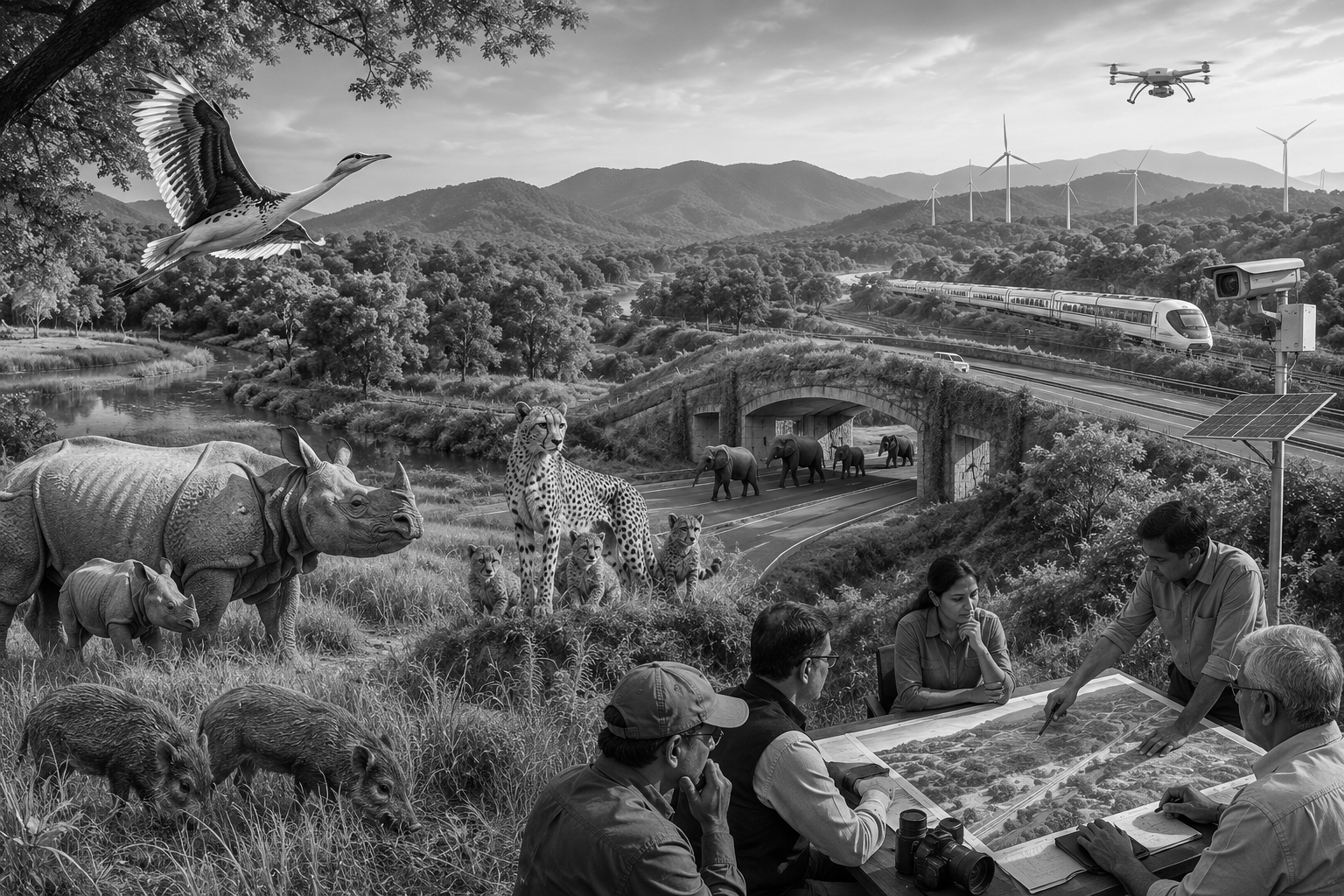
Among the most significant conservation priorities discussed was the long-term strategy for the Greater One-horned Rhinoceros through the Rhino DNA Indexing System (RhoDIS) , a scientific tool that helps identify individual rhinos, strengthen anti-poaching efforts and track illegal wildlife trade.
The committee also reviewed the future conservation strategy for the Great Indian Bustard , one of the world's most endangered birds, and approved the inclusion of the Pygmy Hog under the Species Recovery Programme , expanding national efforts to revive one of the rarest wild pig species on the planet.
Scientific publications relating to the Greater One-horned Rhinoceros, Sloth Bear and Great Indian Bustard were also released during the meeting.
A shift in India's conservation strategy
Experts say the meeting reflects an important evolution in India's wildlife policy. Instead of focusing solely on notifying new protected areas, conservation planning is increasingly centred on improving the quality of existing habitats, restoring wildlife corridors and ensuring that infrastructure projects coexist with biodiversity through scientific mitigation measures .
India currently has an extensive protected-area network comprising 574 Wildlife Sanctuaries, 106 National Parks, 58 Tiger Reserves, 33 Elephant Reserves and 18 Biosphere Reserves , providing protection to some of the world's richest biodiversity.
The country's largest forest cover by area is in Madhya Pradesh , with 77,073 sq km , followed by Arunachal Pradesh (65,882 sq km) and Chhattisgarh (55,812 sq km) . In terms of percentage of geographical area under forests, Mizoram remains the national leader, with more than 85% of its land covered by forests.
Over the past decade, India's protected-area network has steadily expanded, with the number of Wildlife Sanctuaries increasing from around 515 in 2012 to 574 today , reflecting the notification of nearly 60 new sanctuaries by state governments. Unlike public-private partnership models seen in some sectors, wildlife sanctuaries in India are established and managed primarily by state governments and forest departments , with financial and technical support from the Centre.
From protecting forests to rebuilding wildlife
The meeting also underscored India's growing emphasis on species recovery programmes rather than merely expanding protected areas.
Recent years have witnessed several landmark conservation initiatives, including the reintroduction of African Cheetahs in Kuno National Park and later Gandhi Sagar Wildlife Sanctuary under Project Cheetah , making it the world's first intercontinental translocation of a large carnivore.
Captive-bred Pygmy Hogs have been released into restored grasslands in Manas National Park , while the Greater One-horned Rhinoceros has been successfully translocated to strengthen populations beyond Kaziranga National Park . Conservation efforts for the Great Indian Bustard have also entered a new phase with captive breeding and planned soft releases to revive its critically endangered population.
Addressing policy gaps
Despite these achievements, conservation planners acknowledge several persistent challenges. Habitat fragmentation caused by highways, railways, transmission lines and urban expansion continues to isolate wildlife populations. Human-wildlife conflict is increasing as elephants, leopards, bears and other animals venture into agricultural landscapes. Climate change is altering ecosystems through changing rainfall patterns, floods, droughts and forest fires, while post-clearance monitoring of infrastructure projects remains uneven across regions.
The committee's discussions reflected a broader policy shift aimed at addressing these gaps through landscape-level conservation , protecting ecological corridors instead of isolated forests, strengthening scientific monitoring, integrating climate resilience into wildlife management and ensuring continuous compliance with environmental safeguards after project approvals.
Technology is expected to play a central role in this transition through AI-enabled monitoring, camera traps, drones, GPS collars, satellite imagery, DNA fingerprinting and digital wildlife databases , allowing authorities to monitor wildlife populations and habitat health with greater precision.
Development projects are increasingly being encouraged to incorporate wildlife overpasses, underpasses, elevated road sections, power-line mitigation, habitat restoration and continuous ecological monitoring , reducing the ecological footprint of critical infrastructure.
The road ahead
Conservation experts believe India's next phase of wildlife management will depend less on creating large numbers of new sanctuaries and more on strengthening existing protected areas, legally securing wildlife corridors, restoring degraded forests, grasslands and wetlands, expanding species recovery programmes, increasing investment in conservation infrastructure and involving local communities in habitat protection .
With protected areas already spanning much of the country's biodiversity hotspots, the emphasis is shifting towards ensuring that wildlife populations remain genetically connected, habitats remain resilient to climate change and infrastructure development proceeds without compromising ecological integrity.
The deliberations at the 91st SC-NBWL meeting reinforce this vision, one that seeks to harmonise economic growth with biodiversity conservation , ensuring that India's expanding development footprint is matched by equally robust safeguards for its forests, wildlife and natural heritage.