
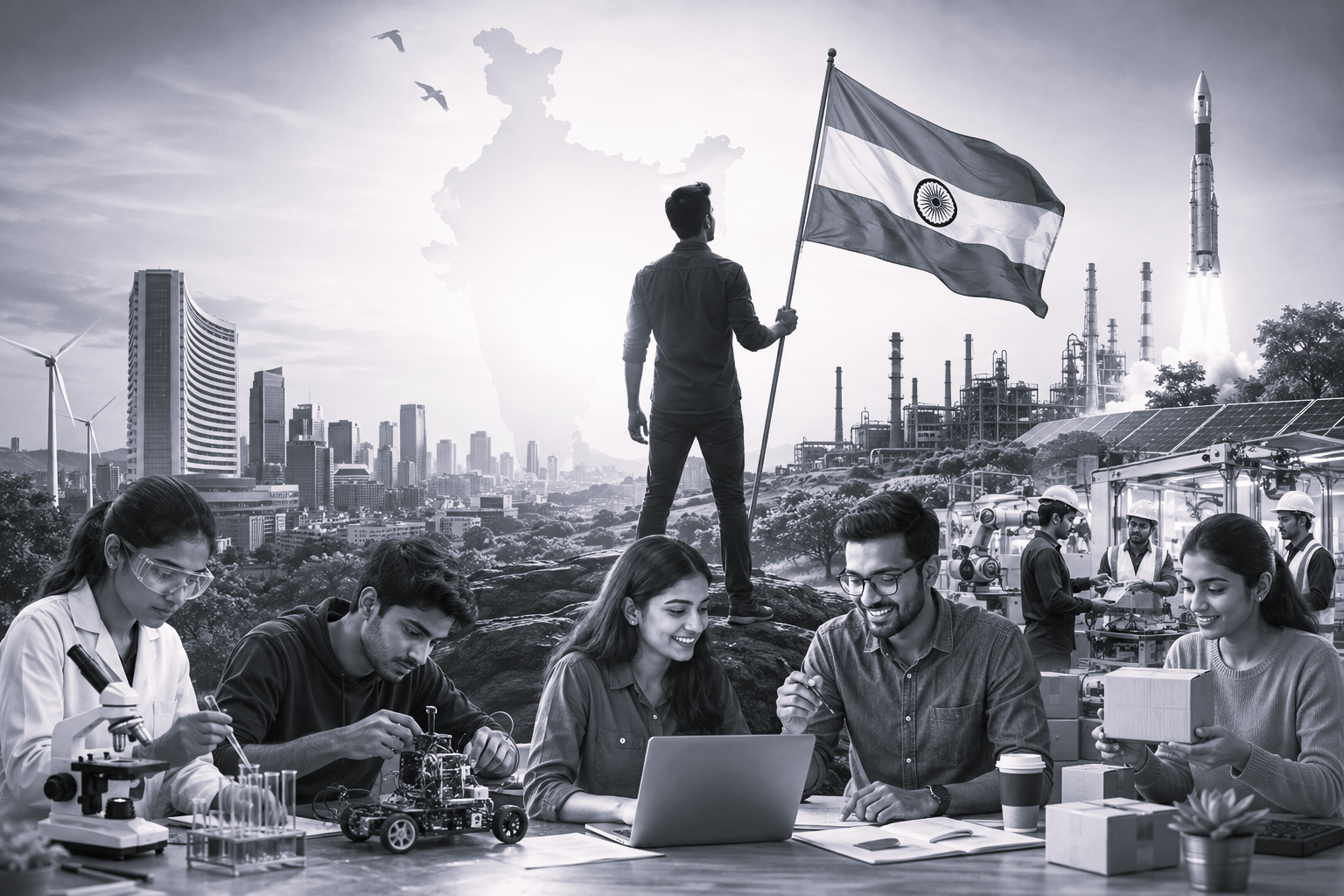
World Entrepreneurs’ Day: Teaching India’s Youth to Take Risks, Create Value and Build the Future
As World Entrepreneurs’ Day approaches on August 21, India has a reason to look beyond the success stories of established industrialists and startup founders and focus on the generation that will shape the country's next economic chapter. Entrepreneurship is not merely about building companies or accumulating wealth; it is about spotting opportunities, solving problems, taking informed risks and creating value for society. For a nation seeking to become a developed economy, empowering young people to become innovators, employers and enterprise builders could be one of the most powerful investments in its future.
History demonstrates how enterprise can reshape a country. Jamsetji Tata viewed industry as an instrument of nation-building, while J.R.D. Tata expanded India's industrial and professional capabilities. Dhirubhai Ambani demonstrated the power of scale and mass-market participation, while Verghese Kurien transformed the lives of millions of dairy farmers through the cooperative model behind India's White Revolution. Later, N.R. Narayana Murthy, Shiv Nadar, Azim Premji and Kiran Mazumdar-Shaw helped build India's global capabilities in technology and biotechnology.
Their legacies show that the greatest entrepreneurs are not necessarily those who accumulate the largest fortunes. They are those whose enterprises create lasting economic, technological and social value.
India Has Opportunity, But Fear Remains
India's entrepreneurial potential is considerable. According to the latest Global Entrepreneurship Monitor (GEM) data, 78.3% of Indian adults saw good opportunities to start a business in their area in 2025, while 83% believed they possessed the skills and knowledge needed to do so. Entrepreneurial intentions stood at 25.6%, while total early-stage entrepreneurial activity reached 12.3%.
Yet a significant barrier remains. Among those who recognised opportunities, 56.8% said fear of failure would prevent them from starting a business. Although the figure has improved from previous years, it shows that India must strengthen young people's ability to deal with uncertainty.
Young Indians therefore should not simply be told to “take risks”. They should learn calculated risk-taking —how to study a market, test an idea, understand the downside, manage resources and learn from failure.
Entrepreneurial risk-taking is not gambling. A reckless person puts resources at stake without understanding the consequences. An entrepreneur gathers information, tests assumptions and decides how much can reasonably be risked.
The mindset should move from “What if I fail?” to “What can I learn, and how can I make failure affordable?”
Education Must Teach Experimentation
Risk-taking ability does not suddenly emerge when a young person decides to launch a company. It develops through years of curiosity, experimentation, decision-making and exposure to uncertainty.
The National Education Policy 2020 has placed greater emphasis on critical thinking, creativity, innovation, experiential learning and problem-solving. The Atal Innovation Mission (AIM) is putting some of these principles into practice. By October 2025, 10,000 Atal Tinkering Labs had been established, engaging more than 1.1 crore students. AIM's wider ecosystem includes 72 Atal Incubation Centres, more than 3,500 startups supported and over 6,200 mentors.
The philosophy is important: students should not only ask, “What is the correct answer?” They should also ask, “What problem can I solve, and can I build a better solution?”
A failed prototype should not automatically be considered a failure. It should become feedback, evidence and learning.
From Business Education to Enterprise Creation
India's premier management institutions have helped transform entrepreneurship from an instinct into a structured discipline.
At IIM Ahmedabad, its entrepreneurship ecosystem has mentored more than 7,000 founders, accelerated over 1,500 startups and provided catalytic capital to more than 700 companies.
The Indian School of Business (ISB) has similarly developed programmes combining academic learning with venture building, mentors, investors and industry networks. Its I-Venture Immersive programme provides a six-month, hands-on venture-building experience, while its grassroots programme extends opportunities beyond conventional degree-based pathways.
The shift is significant:
Education about entrepreneurship is becoming education through entrepreneurship.
Government Support Can Reduce the Cost of Risk
India has developed a substantial entrepreneurial support system. Startup India's current framework includes 65-plus Central Government schemes and initiatives covering seed funding, credit, venture capital, incubation, intellectual property and market access.
The Startup India Seed Fund Scheme can provide eligible startups up to ₹20 lakh as a grant and up to ₹50 lakh through debt or convertible instruments, subject to scheme conditions.
In 2026, the Government also notified Startup India Fund of Funds 2.0 with a ₹10,000-crore corpus, with emphasis on deep technology, innovative manufacturing and early-growth companies. Such support is particularly significant for sectors such as AI, biotechnology, advanced manufacturing and other technologies that require longer development periods.
Credit support is equally important. The Credit Guarantee Scheme for Startups provides government-backed guarantee support to eligible lenders, while the MSME-focused CGTMSE guarantee ceiling was raised to ₹10 crore per borrower from April 2025. Through December 2025, CGTMSE had extended 1.35 crore credit guarantees worth ₹12.39 lakh crore.
For smaller businesses, MUDRA provides institutional credit through Shishu, Kishor, Tarun and Tarun Plus categories. As of February 2025, more than 52 crore MUDRA accounts had been sanctioned, involving ₹33.19 lakh crore.
The Prime Minister's Employment Generation Programme (PMEGP) provides credit-linked subsidies for new micro-enterprises, with subsidy rates reaching 35% for eligible special-category beneficiaries in rural areas. Its portal reports more than 45.6 lakh units assisted and estimated employment generation exceeding 4.10 crore people.
These programmes increasingly form an entrepreneurial ladder—from skills and incubation to finance, production and scale.
MSMEs and PLI Can Create the Next Industrial Generation
India's entrepreneurial story should not be restricted to venture-backed startups. MSMEs are central to broad-based enterprise creation, generating local employment and supporting larger industrial supply chains.
For a young entrepreneur, Udyam Registration can provide an entry point into the formal MSME ecosystem and access to relevant credit, technology, procurement, incubation and marketing support.
The Production Linked Incentive (PLI) programme adds another major opportunity. Covering 14 strategic sectors with an overall outlay of ₹1.97 lakh crore, PLI aims to strengthen domestic manufacturing, investment, productivity and exports.
A young entrepreneur does not automatically qualify for PLI merely by being an MSME. But there is another potentially larger opportunity: becoming a supplier to PLI-supported industries.
Electronics, automobiles, batteries, pharmaceuticals, solar equipment and other sectors require components, packaging, tooling, testing, logistics, engineering and specialised services. A young MSME that develops these capabilities can enter larger supply chains and eventually move towards exports.
MSME gives the platform. Skills create capability. PLI can create industrial demand. Finance provides capital. Supply chains provide scale.
Skills Are the Missing Half
Capital can start a business, but skills determine whether it survives.
The Pradhan Mantri Kaushal Vikas Yojana 4.0 targets people aged 15–45, including school and college dropouts and unemployed youth, with an emphasis on industry-aligned training and practical capabilities.
The Jan Shikshan Sansthan programme extends vocational training to people with limited formal education, including women, SCs, STs, OBCs and minorities.
Skills also make risk more manageable. A person with technical, digital, financial and communication skills has a greater ability to recover if a business fails.
That is why skill development should be treated as an entrepreneurial asset, not merely an employability programme.
A young entrepreneur must know more than how to develop a product. They need to understand pricing, customers, cash flow, marketing, technology, regulations, negotiation and competition.
From Demographic Dividend to Entrepreneurial Dividend
India's young population becomes a genuine demographic advantage only when it is educated, skilled, productive and empowered to create value.
The country does not need every young person to become a founder. It needs young people who can think like problem-solvers, creators and innovators - whether they eventually become entrepreneurs, scientists, engineers, teachers, professionals or public servants.
The pathway is clear:
Curiosity → Economic understanding → Skills → Problem identification → Experimentation → Calculated risk → Innovation → Enterprise → Scale → Employment and social value.
As World Entrepreneurs’ Day approaches on August 21, the occasion offers India an opportunity to look beyond celebrating successful business personalities. It is a moment to think about the millions of young people who could become the next generation of employers, innovators, manufacturers, technology builders and social entrepreneurs.
The ultimate goal is not to create more billionaires or chase startup valuations. It is to create value creators.
A loan can finance a business. A subsidy can reduce its initial burden. A skill can create capability. A mentor can shorten the learning curve. But it is the entrepreneur who must bring these elements together and turn an idea into lasting value.
For India's youth, the defining question should therefore not simply be: “Where can I find a secure opportunity?”
It should increasingly be: “What opportunity can I create for myself, for others and for my country?”
That is perhaps the most meaningful message India can take from World Entrepreneurs’ Day.
If the country can give its young generation the skills, confidence, capital, support and freedom to experiment, young entrepreneurs can become not merely the future of Indian business, but among the most important architects of India's journey towards a developed, innovative and globally competitive nation.