
World's Largest Whale Graveyard Found in Indian Ocean: 476 Fossils, New Species, 5.3 Million Years of History
On the barren seafloor, a sunken whale is the closest thing the deep ocean has to a miracle. It arrives as an all-you-can-eat buffet in a desert, conjuring entire ecosystems from nothing. Scientists have now found the mother of all such miracles, silently accumulating for over five million years.
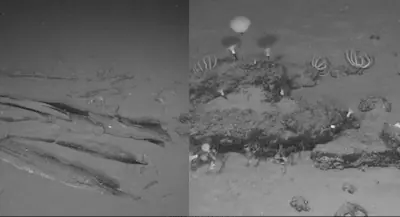
The world's largest, deepest, and oldest known whale graveyard has been discovered in the Diamantina Zone of the southeastern Indian Ocean, extending roughly 1,200 kilometres along the seafloor at depths between 4,616 and 7,001 metres , with 476 fossil cetaceans and five active whale-fall communities recorded. The findings were published in the journal Nature on Wednesday.
The research was conducted aboard the vessel R/V Tansuoyihao , during which the team made 32 dives between February and March 2023 using the human-occupied submersible HOV Fendouzhe . Researchers documented a density of whale remains reaching up to 759.5 individuals per square kilometre .
The fossil record spans at least 5.3 million years , confirmed by strontium isotope dating , placing the earliest whale falls here in the Early Pliocene . Identified fossils include both living beaked whale species such as Andrews' and strap-toothed beaked whales , and extinct taxa, including a newly described species, Pterocetus diamantinae , named after the zone itself.
Previously, most recorded whale falls were found at depths below 4,000 metres, with the deepest active site known at 4,204 metres in the Southwest Atlantic. No active whale-fall ecosystems had ever been reported from hadal depths exceeding 6,000 metres before this discovery.
The Diamantina Zone's richness is no accident: it sits along the migration routes of several baleen whale species , while its deep waters attract beaked whales hunting squid and fish . Some of these animals likely died during hunting trips into trenches that lie below their maximum diving depths .
The zone's V-shaped topography funnels sinking carcasses onto the trench floor, while low sedimentation rates and the mineral-dense nature of whale bones prevent decomposition, leaving fossils exposed for millions of years.
Thriving on the carcasses were sea cucumbers, squat lobsters, saltwater clams, jellyfish, tubeworms, and brittle stars, many likely species never previously documented , powered by chemical-eating microbes rather than sunlight. Even fully depleted mineral skeletons serve a final purpose, acting as scaffolds for corals and suspension feeders to build upon.
Craig Smith of the University of Hawai'i called the find "truly extraordinary." Nick Pyenson of the Smithsonian National Museum of Natural History called it "something really special," adding that 'megasite' is a totally appropriate term .