
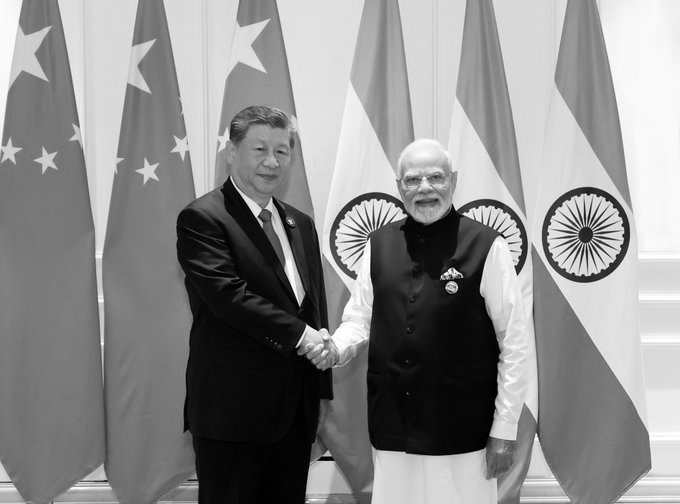
Xi-Modi Reset? China Says Delhi Talks Produced A ‘Most Important Consensus’
Chinese Foreign Minister Wang Yi said President Xi Jinping and Prime Minister Narendra Modi reached the “most important consensus” during their New Delhi meeting that China and India should be partners rather than rivals, signalling a fresh push to stabilise ties after years of tensions.
Xi visited New Delhi on September 12-13 for the 18th BRICS Summit, his first visit to India in seven years. During his meeting with Modi on the sidelines of the summit, the two leaders discussed the long-term direction of bilateral relations, the border issue, trade and wider cooperation.
Wang said Xi stressed that China and India can draw on each other’s strengths, support one another and pursue common development. The leaders agreed to jointly maintain peace and tranquillity along the border and support each other’s BRICS chairmanships.
According to Wang, Modi said India was ready to be a partner, not an adversary, to China and viewed the other country’s development as an opportunity rather than a challenge. Modi also said India’s China policy was independent of third-party influence and that India would not allow forces to conduct anti-China activities on its territory.
The Indian side’s official readout said Modi stressed that mutual respect, mutual sensitivity and mutual interest should guide bilateral ties. He said differences should not become disputes and underlined that peace and tranquillity in border areas remain essential for continued development of relations. Both sides agreed to pursue a fair, reasonable and mutually acceptable settlement of the boundary question.
The leaders also discussed structural trade imbalances, supply-chain issues and market access, while agreeing to expand business links, cultural exchanges, people-to-people ties and direct air connectivity. Bilateral trade hit a record $155.6 billion in 2025, although India continues to face a large trade deficit with China.
Wang said China-India relations had moved from a “restart” to a “renewed elevation”, with trade and people-to-people exchanges expanding. He said both sides should build political trust, appropriately manage differences and prevent ties from stagnating or backsliding.
The two countries also agreed to coordinate through the BRICS, United Nations, Shanghai Cooperation Organisation and G20, while promoting cooperation among Global South countries.
China will take over the BRICS chairmanship in 2027 after India’s 2026 tenure. The leaders also backed a more multipolar world order and said China and India should act as stabilising forces amid global uncertainty.